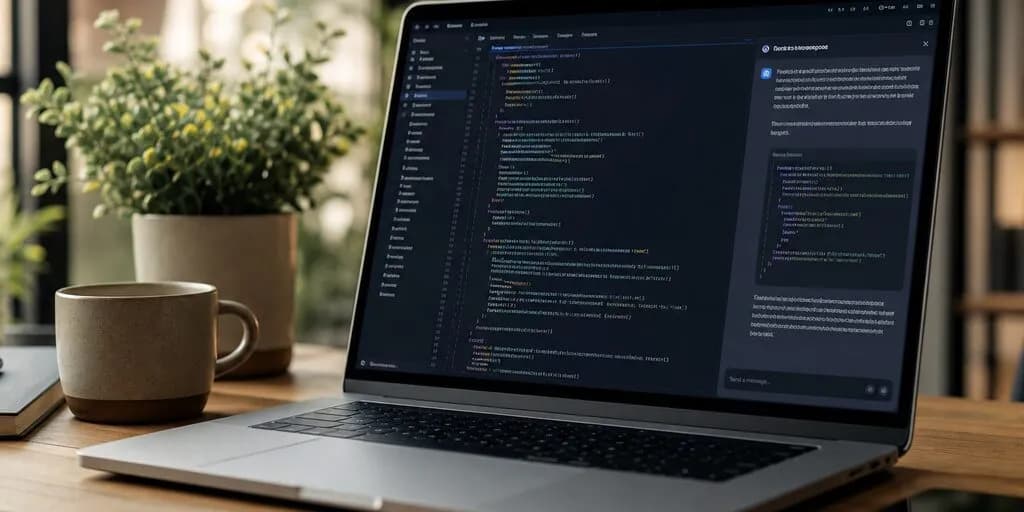
If you follow tech news you've probably heard the term "vibe coding". If not — you will, very soon. It's simultaneously the hottest topic and the most divisive phenomenon in web development in 2026. In this article we'll explain what vibe coding is, why it splits the developer community, and — honestly — when it works and when it's a disaster.
What is vibe coding?
The term was coined by Andrej Karpathy (former director of AI at Tesla and co-founder of OpenAI) in early 2025. The concept is simple: instead of writing code line by line, you describe what you want to an AI and it generates the code for you. You guide, review and approve.
What does vibe coding look like in practice?
A real example. Instead of writing by hand:
const fetchUserData = async (userId) => {
  try {
    const response = await fetch(`/api/users/${userId}`);
    if (!response.ok) throw new Error('Failed to fetch');
    return await response.json();
  } catch (error) {
    console.error('Error:', error);
    throw error;
  }
};
You tell the AI: "Write a function that fetches user data by ID from an API, handles errors properly and is async" — and you get exactly the code above.
With vibe coding you go further: you describe entire features, not just individual functions. "Build me a CRM with users, tasks and a dashboard" — and the AI scaffolds the whole application.
When does vibe coding work brilliantly?
Prototyping and MVPs
Want to validate an idea quickly? Vibe coding is perfect. In hours you have a working prototype, without spending days writing boilerplate.
Repetitive tasks
CRUD operations, forms, API endpoints, admin panels — AI generates all of this reliably. Why write the same thing for the 20th time?
Solo developers
If you work alone and need to cover full-stack development, AI is like having a junior developer who works 24/7 — no holidays, no quitting.
Technologies outside your comfort zone
Need a WordPress plugin but you're not a PHP developer? A Python script but you write JavaScript? AI fills that gap.
When is vibe coding a disaster?
Here comes the honest part most articles skip.
Security
AI-generated code regularly misses SQL injection protection, validates input incorrectly, and leaves security holes. If you don't understand security — you don't see the problem until it's too late.
Scalability
AI is excellent at generating working code. It's not excellent at generating efficient code at scale. N+1 query problems, unoptimised queries, memory leaks — all of this hides in AI-generated code and surfaces under load.
Maintainability
If you don't understand the code, you can't maintain it. When there's a production bug, the AI will suggest 5 different "fixes" — none of which may be correct if you don't understand why the problem is happening.
Complex business logic
Complex business rules, industry-specific requirements, integrations with legacy systems — AI struggles with all of these. The result is code that technically works but doesn't do exactly what it should.
The split in the community
"Vibe coding is the future"
Startup founders, solo developers and entrepreneurs embrace vibe coding. Their arguments: speed, accessibility, democratisation of development. "Now anyone can build their idea."
"Vibe coding is a dangerous myth"
Senior developers with experience in production systems are sceptical. Their argument: 68% of developers use AI, but only 25% of production code is AI-generated — for a reason. Debugging code you don't understand is a nightmare.
Reality is somewhere in between.
The numbers behind the hype
| Metric | Value | Source / context |
|---|---|---|
| Developers using AI for coding | 68% | Figma AI Report 2025 |
| AI-generated code in production | 25% | Average share in real systems |
| Productivity gain | 3× | When used correctly |
| Annual AI market growth to 2030 | 37% | Global forecast |
Our position at Singularity Edge Studio
We use AI tooling daily — GitHub Copilot, Claude, ChatGPT. They speed up our work significantly. But "vibe coding" in its pure sense — generating production code without deep understanding — is not our approach.
Why? Our clients pay us not just for code that works today. They pay for:
- ✓A secure system that can't be hacked
- ✓Code that can be maintained 2 years from now
- ✓A system that works at 10× the user load
- ✓Architecture that allows new features to be added
These things require understanding, experience and accountability — things AI tooling amplifies, but doesn't replace.
Practical guide: how to use AI correctly
Use AI for
- Generating boilerplate
- Writing tests
- Documentation
- Code review and suggestions
- Rapid prototyping
Don't rely on AI alone for
- Architectural decisions
- Security implementations
- Critical business logic
- Performance optimisation
- Production-ready code without review
Experienced developer + AI ≠ beginner + AI
An experienced developer with AI is 5× more productive. A beginner with AI still makes beginner mistakes — just faster. AI multiplies your competence, it doesn't replace it.
The future: augmented developers, not replaced ones
Figma put it well: "One experienced developer with the right AI tooling will manage a team of agents with the effectiveness of 4–5 engineers."
The key phrase is experienced developer.
// SINGULARITY EDGE STUDIO
AI-augmented development, without vibe-coding risks
We use AI tooling wisely — for speed and quality, not to replace our accountability to the client. Every line of production code goes through review, tests and architectural thinking.
- MVP and prototypedays, not weeks
- Production systemwith code review and tests
- Post-launch maintenancecode we understand
Have an idea but don't want "vibe-coded" code in production?
Free consultation — we discuss how to use AI for speed without sacrificing security or maintainability.
Get in touch →Conclusion
Vibe coding is neither the revolution that will kill programmers, nor a dangerous toy for amateurs only. The truth is more nuanced:
- ✓For prototypes and MVPs — great
- ✓For repetitive tasks — indispensable
- ⚠For production systems without oversight — risky
- ✕To replace an experienced developer — impossible (for now)
If you want a system where you understand every line of code and can maintain and evolve it — get in touch. We use AI tooling wisely, but accountability for the end result is entirely ours.
// TOPICS
Author
Singularity Edge Studio
Engineering studio for web and software — Plovdiv, Bulgaria. We build corporate sites, SaaS, e-commerce, and DevOps infrastructure with a focus on measurable outcomes.
// MORE ARTICLES
AI and Web Development — How Artificial Intelligence Is Changing the Industry in 2026
AI didn't replace developers, but it changed timelines, prices, and tools. What's actually being used, what AI can't do, SEO, chatbots, security, and what it means for your business.
AIWhat Is MCP (Model Context Protocol)? A Complete Guide to AI Integrations in 2026
Model Context Protocol standardises how AI models connect to external systems. How MCP works, why it cuts complexity from N×M to N+M, and how businesses can benefit in 2026.
AIOne Developer = a Whole Team: How AI Agents Changed Web Development and Software Engineering
Rakuten cut Time-to-Market from 24 to 5 days with Claude Code. We're entering the era of the "One-Person Crew" — how autonomous AI agents, multi-agent systems, and 1M context windows change ROI, roles, and SEO.