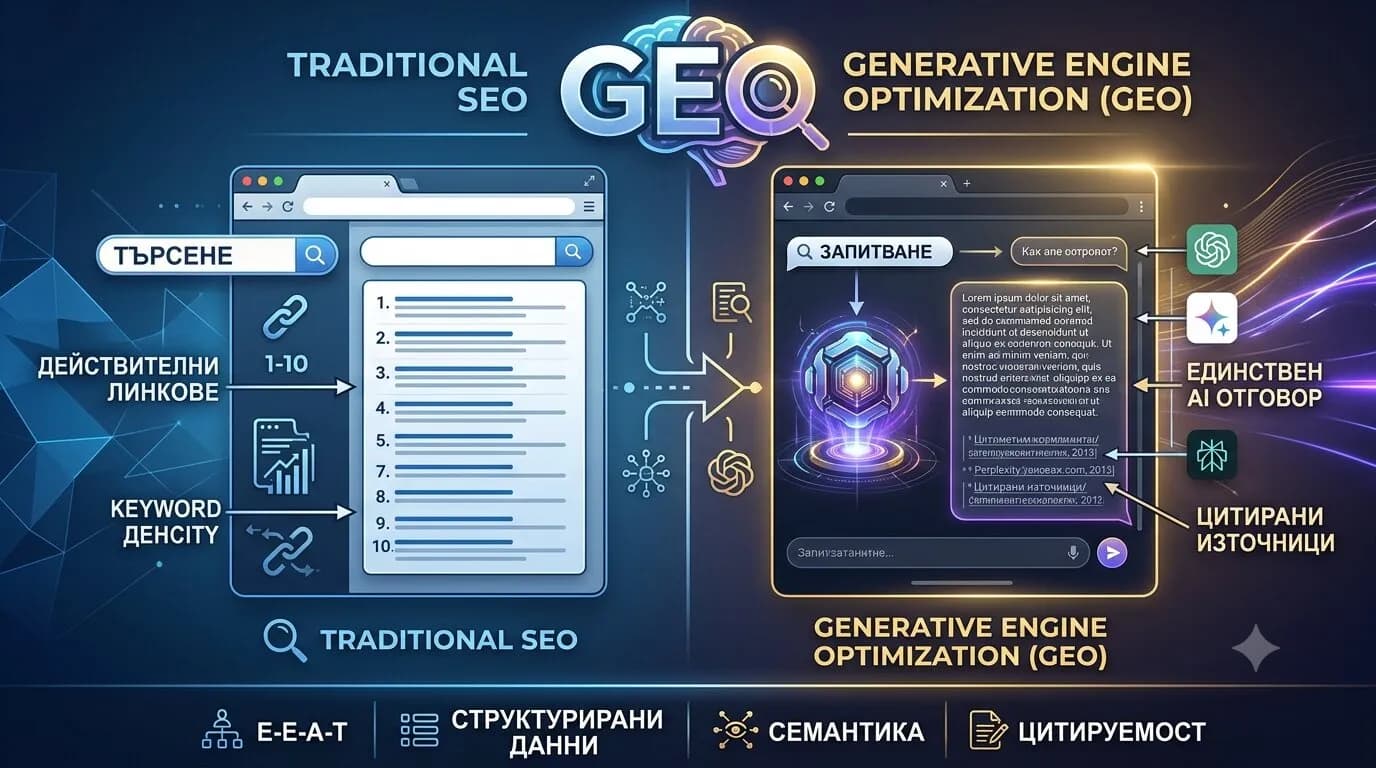
Traditional search engine optimization (SEO) as we knew it over the past decade is no longer sufficient for a digital business to survive. While classic SEO is entirely focused on Google's algorithms and ranking in the so-called "ten blue links," the reality in 2026 is fundamentally different.
Millions of paying users ask their complex searches and commercial questions directly in the interfaces of large language models (LLMs) — ChatGPT, Gemini, Perplexity, and Claude. They receive a single, synthesized answer without opening dozens of websites.
If your business is not present in the sources these systems cite, you are practically invisible to a huge and rapidly growing audience. This new discipline has an official name: GEO — Generative Engine Optimization.
Related resources: SEO + AI service · Free audit · ChatGPT & Perplexity
What Is GEO: The Fundamental Paradigm
GEO is a strategic practice of optimizing digital content, web architecture, structured data, and overall online presence to achieve maximum visibility and citability in the answers of generative AI systems. The difference between classic SEO and the new GEO is fundamental and completely changes the way we think about creating content.
Traditional SEO
Search → list of 10 blue links → the user chooses. You can be in 3rd position and still get traffic.
Generative Engine Optimization
Question → synthesized AI answer with 2–3 selected citations. AI is the filter — you're either in, or you don't exist.
With GEO, the choice becomes binary: either you are part of the AI's consensus answer, or you do not exist for the user at all. This has enormous economic consequences for every site that relies on incoming organic traffic.
Why GEO Is a Business Survival Issue Right Now
Figures from global studies outline an irreversible tectonic shift in user behavior in 2026:
- ✓OpenAI's ChatGPT has crossed the threshold of 1 billion weekly active users and, with web search, has become a direct replacement for the classic search engine
- ✓Perplexity AI processes over 100 million complex commercial queries weekly with a high conversion rate
- ✓Google AI Overviews (SGE) now appear in over 25% of all searches in the US and are progressively rolling out across the EU and Bulgaria
Gartner's forecasts are coming true — traditional search volume on Google is down by nearly 25%, as users redirect their informational needs to conversational AI assistants. Traffic is not disappearing — it is simply changing its software channel of arrival.
The Anatomy of AI Selection: How LLMs Choose Their Sources
Unlike Google, whose signals are well studied (backlinks, keywords, Core Web Vitals), generative engines work on a fundamentally different principle. Research in RAG (Retrieval-Augmented Generation) systems shows four critical factors for selection.
Authoritativeness and Verifiability (E-E-A-T)
LLM models have a built-in safeguard against misinformation and "hallucinations." That is why RAG systems give preference to content from recognized authorities. Sites with clear E-E-A-T (Experience, Expertise, Authoritativeness, Trustworthiness) signals are cited up to three times more often than anonymous blogs or new domains.
Structural and Syntactic Accessibility
An LLM must read and synthesize your page in milliseconds. If the content is an unstructured "wall of text," extraction is difficult. Texts with clear sections, numbered lists, tables, and short definitions are ranked with priority.
Specificity vs. Generic Fluff
AI models reject marketing "filler." Texts with real statistics, precise numbers, concrete examples, formulas, and official definitions have a much higher chance of being cited — they carry high information density.
Data Recency
Perplexity and web search in ChatGPT and Gemini rely on real-time processing. For dynamic topics (law, finance, technology, local business), agents deliberately filter outdated content and look for recently published documents.
Comparative Analysis: The Differences Between SEO, AEO, and GEO
In modern marketing, three similar terms are often used that easily confuse business owners. Here are their precise boundaries and goals.
| Characteristic | SEO | AEO | GEO |
|---|---|---|---|
| Primary goal | First page in Google (SERP) | "Position zero" (Featured Snippet) | Inclusion in the synthesized LLM answer |
| End result | 10 blue links | Short card in Google | Chat answer with citations |
| Main focus | Backlinks, keywords, UX | Short, direct answers | Semantics, E-E-A-T, structured data |
| Interface | Browser search engines | Google, Bing | ChatGPT, Gemini, Claude, Perplexity |
The three disciplines overlap (a broken and slow site will not rank anywhere), but GEO requires a qualitatively new strategy for building the textual architecture of your pages.
6 Key Strategies for GEO Dominance in 2026
Highly Structured Content with Clear Definitions
Organize content to make it as easy as possible for AI companies' software parsers:
- ✓Inverted pyramid model — start each section with a crystal-clear definition in 1–2 sentences
- ✓H2/H3 headings as questions — instead of "Our services," use "What are the steps for optimizing corporate taxes?"
- ✓FAQ blocks — the favorite structure of ChatGPT and Gemini, because it matches their conversational model
Deep Schema.org (JSON-LD) Integration
For AI models to understand exactly who you are, speak their native language — structured data. Here are the five most important Schema types for GEO:
| Schema type | Role for GEO |
|---|---|
| Organization | Links all mentions of your brand into a single entity — logo, contacts, sameAs profiles |
| LocalBusiness | Critical for local businesses — precise NAP (Name, Address, Phone), opening hours, categories |
| FAQPage | Carries question-answer pairs at code level — AI extracts them instantly |
| HowTo | Structures step-by-step instructions — ChatGPT loves citing them for technical queries |
| Article + author | Never "admin" — an embedded Person object with links to LinkedIn and credentials = a direct E-E-A-T signal |
@type: "Organization", name,
url, logo, and a sameAs array with your official LinkedIn and Facebook profiles.
Test the code via Google's Rich Results Test.
Maximum Strengthening of E-E-A-T Signals
- ✓Author section — every article ends with a detailed biography, education, and a link to LinkedIn
- ✓Cite authorities — for AI to cite you, you must link to Gartner, McKinsey, Statista, and government institutions
- ✓Real practical experience — phrases like "In our practice in Plovdiv, we found that…" signal unique, primary content
Optimization for "Citability"
- ✓Short, tight sentences — one thought or fact per sentence, without complex subordinate clauses
- ✓Isolate key data — statistics and numbers in separate sentences or tables, not hidden in long paragraphs
- ✓Bullet points — AI copies and integrates them into its answers with exceptional ease
Presence Beyond Your Own Site (Off-Page GEO)
LLM models are trained on the entire web. Your brand must exist as a recognizable entity everywhere:
- ✓Business directories — optimized presence with real reviews on Clutch.co, GoodFirms, and Sortlist
- ✓LinkedIn expertise — authoritative articles from key figures build a semantic link between the expert and the organization
- ✓Open Source (GitHub) — for technical companies, this is a strong signal for Microsoft Copilot and ChatGPT
Local GEO Engineering
- ✓Google Business Profile — the most important source; Gemini is natively integrated with Google Maps and GBP
- ✓Review management — AI reads review text and cites your customers' words directly in the answer
- ✓Local semantic context — include neighborhood names, landmarks, and regional terms
How to Measure GEO Effectiveness: Next-Generation Metrics
OpenAI and Anthropic do not provide a panel like Google Search Console. Nevertheless, there are professional methods for measuring GEO success.
AI Referral Traffic (GA4)
Track in Traffic Acquisition → Referral for domains: openai.com, perplexity.ai, gemini.google.com.
Consensus Query Testing
Monthly, ask AI without mentioning your brand: "Who are the leading Next.js agencies in Bulgaria and why?".
Brand Mentions
Brand24, Mention, BuzzSumo — growth in mentions correlates with the frequency of AI citations.
AI Citation Rate
A new metric (Rankscale, Profound) — the new equivalent of classic Share of Voice.
GEO Strategies by Business Model
Local Services (Plovdiv and the Region)
Battleground: Gemini + Google AI Overviews. Detailed LocalBusiness schema, every service as a separate element in GBP, long text reviews mentioning the city name.
B2B and Professional Services
Battleground: ChatGPT, Perplexity, Claude. Whitepapers, comparative analyses, and detailed case studies with real financial results.
E-commerce
Battleground: Perplexity Shopping. Full Product Schema (price, availability, SKU, rating), FAQ for the product, and comparison tables.
Complete 90-Day Tactical Implementation Plan
So these concepts do not remain on paper alone, here is a chronological plan developed by the engineering team at Singularity Edge Studio that will let you get ahead of the competition within one quarter.
Days 1–30: Software and Technical Foundation
- ☐robots.txt audit — ensure GPTBot, ChatGPT-User, Google-Extended, and PerplexityBot have access
- ☐Full Schema implementation — clean JSON-LD for Organization, LocalBusiness, and authors; test with Rich Results Test
- ☐NAP synchronization — identical name, address, and phone everywhere (site, Facebook, LinkedIn, GBP, directories)
Days 31–60: Content Transformation
- ☐FAQ blocks — 3–5 precise questions and answers on every key page with clear H3 headings
- ☐Rewrite introductions — remove empty marketing intros; start with facts and numbers
- ☐Author profiles — a dedicated page with a real photo, biography, credentials, and external links
Days 61–90: External Authority and Monitoring
- ☐Review campaign — ask satisfied clients for detailed reviews on GBP and Clutch.co
- ☐Publications in authoritative media — guest posts and interviews as external validation for AI
- ☐Regular GEO audit — monthly tests in ChatGPT, Gemini, and Perplexity to track AI Citation Rate
3 Real Examples of GEO in Action
Dental Clinic (Sofia)
"I'm looking for a 24-hour dentist in Lozenets with good reviews for pediatric dentistry."
A clinic with clean LocalBusiness JSON-LD (openingHours: "Mo-Su 00:00-24:00") and a FAQ for children is placed first. The clinic with a beautiful but unreadable site is passed over.
Accounting Firm (Plovdiv)
"What are the specifics of VAT registration for a dropshipping business?"
A 2021 article with generic paragraphs is ignored. The updated article with a threshold table and numbered list, signed by an auditor with LinkedIn, is cited directly.
Next.js Web Agency
"Which agency has experience migrating from WooCommerce to headless Next.js?"
Empty claims like "We are the best" are skipped. A detailed case study with Core Web Vitals results and a link to GitHub generates a warm B2B lead.
GEO Does Not Replace Technical SEO
The two work in symbiosis. Lightning-fast speed (PageSpeed above 90/100), clean mobile responsiveness, HTTPS, and natural backlinks remain a baseline requirement for the AI bot to bother reading your site at all. See why speed loses customers → and our Core Web Vitals guide →
FAQ: Generative Engine Optimization
What is GEO in one sentence?
GEO is the optimization of content and structured data so that your business is cited in the synthesized answers of generative AI models (ChatGPT, Gemini, Perplexity, Claude).
Does GEO replace SEO?
No. GEO builds on SEO. The technical foundation (speed, mobile, HTTPS, backlinks) remains mandatory — GEO adds a layer of structure, citability, and authority.
What is the most important first GEO move?
A complete and correct Schema.org (JSON-LD) implementation for Organization/LocalBusiness plus verification that robots.txt does not block AI bots (GPTBot, PerplexityBot, Google-Extended).
How do I know if AI is citing me?
Track AI referral traffic in GA4 (openai.com, perplexity.ai) and run monthly test queries on all three platforms without mentioning your brand.
Does content freshness matter?
Enormously. Perplexity and web search in ChatGPT/Gemini filter outdated content for dynamic topics. Update key articles regularly.
// SINGULARITY EDGE STUDIO
How We Prepare You for the GEO Era
We are not passive observers of the AI revolution — we build the digital infrastructure for tomorrow and implement full GEO readiness in every layer of the code.
- Next-generation architectureUltra-fast headless applications on Next.js, React, Node.js with SSR
- JSON-LD engineeringClean, customized structured data per Schema.org
- Semantic audit and contentFAQ blocks, definitions, and E-E-A-T signals for maximum AI Citation Rate
- Local GEO dominanceGBP, NAP synchronization, maps, and directories
Request Your Custom GEO Audit
We will analyze your site's structure, Schema data, and citability — with a concrete plan for AI visibility.
Request a GEO audit →Conclusion: Are You Ready for the Era After the Ten Blue Links?
The time when it was enough to fill a page with keywords and buy a few cheap links is over. Users in 2026 value their time and trust artificial intelligence to filter the internet for them.
Generative search engines are not a threat — they are the biggest market opportunity since the rise of Google. Businesses that invest today in precise structure, Schema markup, E-E-A-T, and citability will build an unbeatable advantage for years to come.
The only question is: when your perfect client asks Perplexity or Gemini who to buy from tomorrow — will artificial intelligence speak the name of your company?
// TOPICS
Author
Singularity Edge Studio
Engineering studio for web and software — Plovdiv, Bulgaria. We build corporate sites, SaaS, e-commerce, and DevOps infrastructure with a focus on measurable outcomes.
// RELATED FAQ
// MORE ARTICLES
How Does AI Discover Your Business? Why ChatGPT Doesn't Recommend Your Site — and How to Fix It
Classic SEO is no longer enough. How ChatGPT, Gemini, Perplexity and Claude choose whom to cite, 15 reasons you're invisible, practical tests, llms.txt, Schema.org and a 25-step AI Visibility checklist.
SEOAI Ready Website: 20 Mandatory Characteristics of a Modern Site in 2026
A beautiful, fast site is no longer enough. What AI Ready Website means, why GEO and AEO are replacing classic SEO, and 20 mandatory characteristics — from Core Web Vitals and Schema.org to llms.txt, APIs and AI agents.
SEOHow to optimise your website for ChatGPT and Perplexity — the complete 2026 guide
AEO, GEO and AIO — what AI SEO is, how AI models choose who to cite and 8 practical steps to become a source of answers in ChatGPT, Perplexity and Google AI Overview.