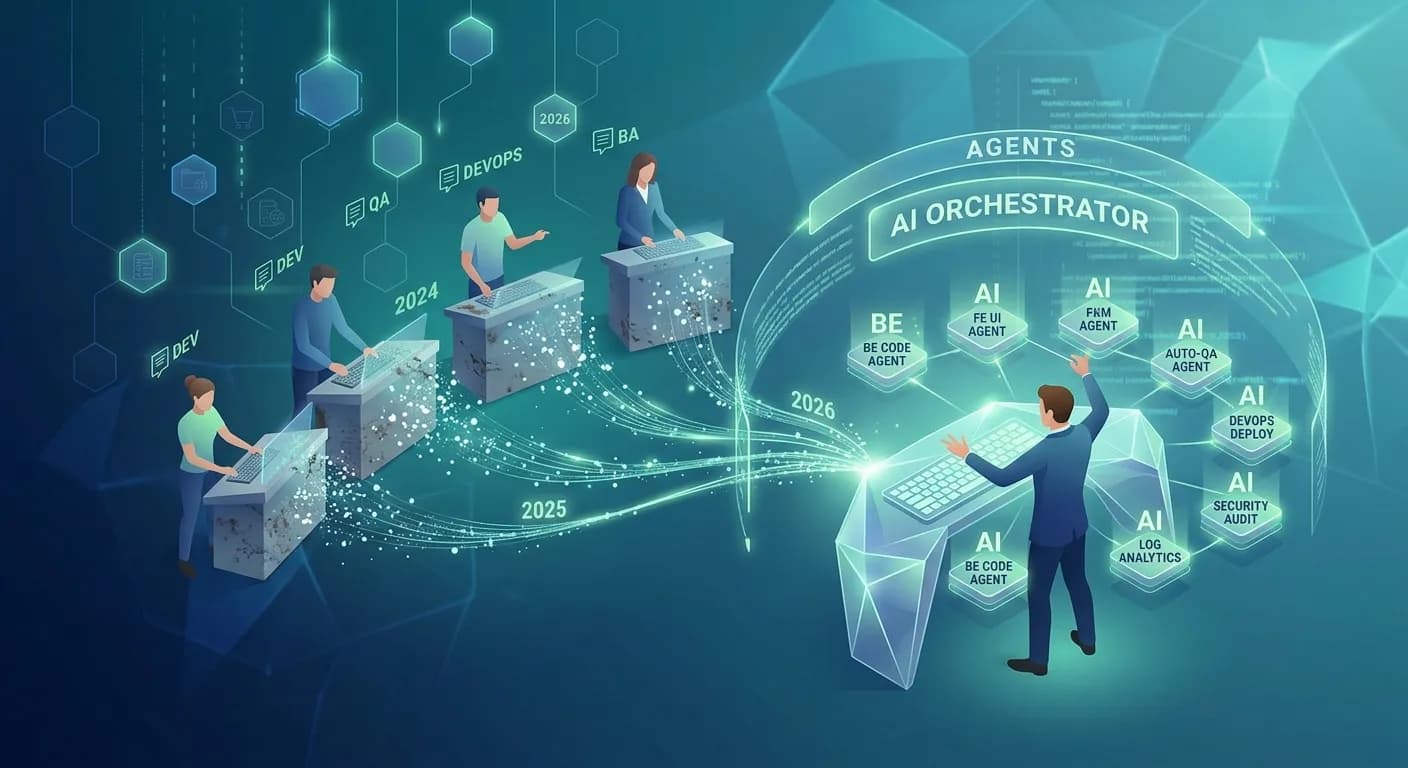
At the start of the year, Dario Amodei, CEO of Anthropic, made a prediction that sent shockwaves through the technology industry: "A two-person company built entirely around AI has already reached a billion-dollar valuation. The next logical step is teams of autonomous AI agents operating at the level of entire corporate organisations."
To many outsiders this sounded like a distant futuristic dystopia or yet another Silicon Valley marketing bubble. Reality, however, shows that this prediction isn't just coming true — it's already transforming business models at a staggering pace.
Japanese tech conglomerate Rakuten recently announced a crushing statistic: the company has reduced Time-to-Market for new software features from 24 working days to just 5 days. This revolutionary optimisation was achieved through deploying Claude Code — a specialised AI agent system for autonomous code development. We're talking about a fivefold (500%) acceleration of the production cycle.
We're entering the era of the so-called "One-Person Crew", where the boundaries of individual productivity are completely redefined. In this comprehensive guide, experts from Singularity Edge Studio analyse the anatomy of AI agent development.
1. From assistant to agent — the fundamental paradigm shift
To understand the depth of the current technological transformation, we need a clear distinction between tools from the recent past and modern autonomous systems.
Evolution of AI in development:
[Intelligent Autocomplete (2022-2024)] ──► [Contextual Assistants (2025)] ──► [Autonomous AI Agents (2026)]
The Copilot era (2022–2024)
Just two years ago, AI tools in software engineering functioned mainly as "smart autocompletion" (Inline Autocomplete). The developer wrote a line of code, and artificial intelligence (for example early versions of GitHub Copilot) predicted and suggested the next few words or a short function. This undoubtedly saved time on tedious boilerplate writing, but essentially differed little from an advanced predictive text system (IntelliSense). The intelligence was local, reactive, and heavily limited.
The Contextual Assistant era (2025)
As context windows of large language models (LLMs) grew, tools began to understand the content of the entire open file. Users could hold a chat dialogue within their development environment (IDE) and request generation of more complex functions or local debugging. However, control and execution remained entirely in human hands — AI suggested, the human copied, pasted, and tested.
Current reality: Autonomous AI Agents (2026)
Today the paradigm is fundamentally different. The modern AI agent doesn't just help the developer — it executes tasks autonomously end to end. The difference lies in the ability to plan, self-correct, and use tools (Tool Use).
When a modern AI agent (like Claude Code or Cursor Agent) is given a task, its workflow includes:
- Analysis and scanning: Reading and understanding the entire project architecture (codebase).
- Planning (Chain-of-Thought): Preparing a step-by-step plan for changes spanning multiple files, modules, and databases.
- Execution: Autonomously modifying existing software code and creating new components.
- Validation: Independently running compilers, linters, and test suites in an isolated environment.
- Iteration and self-correction: If a test fails, the agent analyses the log, fixes the code, and repeats the process.
Real-world business analogy: The difference is equivalent to telling an administrative assistant: "Here's the next word to write in the letter" (2023 model) versus "Here's the project goal, here's the budget and access to our systems — analyse the market, prepare the strategy, test it, and present me with the finished, working end product" (2026 model).
Under this new model of work, the software engineer is no longer simply a wielder of the text tool (code monkey). They are an architect, product manager, and auditor who sets business goals, defines strategic direction, and validates final results.
2. Multi-Agent system architecture: The power of coordinated intelligence
If a single standalone AI agent can drastically accelerate individual productivity, the true corporate revolution lies in so-called Multi-Agent systems (multi-agent networks).
                    ┌─────────────────────────┐
                    │  LEAD AI AGENT          │
                    │ (Orchestrator / Manager)│
                    └────────────┬────────────┘
                                 │
         ┌──────────────────────────┼──────────────────────────┐
         ▼                          ▼                          ▼
┌──────────────────┐       ┌──────────────────┐       ┌──────────────────┐
│  AI AGENT        │       │  AI AGENT        │       │  AI AGENT        │
│  (Log Analysis)  │       │  (Deploy Timeline)│      │  (Testing/QA)    │
└──────────────────┘       └──────────────────┘       └──────────────────┘
In a properly configured multi-agent system there is a clear hierarchy:
-
✓
Lead agent (Orchestrator/Manager): Accepts the large business task, decomposes it into subtasks, and distributes them to specialised agents. Monitors deadlines and integrates separate code pieces.
-
✓
Specialised sub-agents: Have strictly limited context, specific tools, and execute their narrow task with maximum focus.
Simulating a real production incident
Standard scenario: critical outage on an e-commerce website during a campaign.
Before (Traditional model)
The system sends a 500 error signal. The support team is woken up. Chaotic digging through Server Logs begins, checking deployments, analysing metrics and tickets. Root Cause Analysis often takes 2–6 hours.
Now (Multi-agent ecosystem)
The lead AI agent starts an investigation and activates sub-agents in parallel: git commits, ElasticSearch logs, PostgreSQL load, customer complaints. A hotfix is ready for approval. Response time: under 3 minutes.
3. The technological leap of Claude Sonnet 5 and the context window revolution
The quantum leap in autonomy is due to the latest generation of LLMs, led by Claude Sonnet 5 from Anthropic. Released as the standard engine in Claude Code, this model introduced a native 1 million token context window.
| Characteristic | Previous models (Legacy LLMs) | Claude Sonnet 5 (Current reality) |
|---|---|---|
| Context size | 4,000 – 32,000 tokens | 1,000,000+ tokens |
| Reading methodology | Reading "chapter by chapter" (loss of connection) | Reading the entire library at once |
| Dependency understanding | Limited to the current file | Full understanding of architectural relations |
| Hallucination rate | High on large projects | Minimal, thanks to cross-references |
When an AI agent has 1 million tokens of context, it can load the entire codebase of a medium-sized enterprise application — all controllers, models, migrations, configurations, API integrations, and frontend components simultaneously. Previous models suffered from software "amnesia." Claude Sonnet 5 sees the project as a single, living organism.
Leading design platforms, including Figma, confirm the trend: "An experienced Full-Stack developer equipped with a modern multi-agent AI environment today possesses the operational productivity that until recently required an entire team of 4 to 5 engineering specialists."
4. What does "AI Agent" mean for non-technical business? Translated into ROI
If you're a CEO, entrepreneur, or marketing manager, abstract terms like "tokens", "LLM", and "context windows" probably sound distant. Let's translate the technological revolution into financial metrics.
The traditional software process (Before)
Business analysis → architecture → weeks of coding → QA → iterations.
Total time: 3–5 weeks. Labour cost: High.
The AI agent-driven process (Now)
The engineer describes requirements. The AI agent creates the database, API, UI, and tests. The engineer guides and approves.
Total time: 3–5 days.
Direct business impact for companies
-
✓
Drastic Time-to-Market reduction: Ideas become working products weeks faster.
-
✓
Budget optimisation: Budget goes to strategic planning, not mechanical code writing.
-
✓
Production stability: AI agents don't skip Unit Tests — outage risk is minimised.
-
✓
Efficient scaling: A team of 2–3 engineers with AI agents can maintain Enterprise platforms.
5. Task anatomy: Where AI dominates and where humans remain irreplaceable
┌──────────────────────────────────────────────────────────────────────────┐
│ TASK CATEGORISATION IN DEVELOPMENT                                         │
├──────────────────────────────────────────────────────────────────────────┤
│ [Category 1: Fully Automated] ──────────────────────── 5-10× Acceleration │
│ (Unit tests, Refactoring, Documentation, API integration)                 │
├──────────────────────────────────────────────────────────────────────────┤
│ [Category 2: Significantly Accelerated] ────────────── 2-4× Acceleration  │
│ (New features, Figma-to-Code, Code optimisation)                          │
├──────────────────────────────────────────────────────────────────────────┤
│ [Category 3: Human Strategic Control] ───────────────── Tool/Oversight     │
│ (Software Architecture, Business logic, Security, UX strategy)            │
└──────────────────────────────────────────────────────────────────────────┘
Category 1 — Fully automatable tasks (5–10× acceleration)
- ✓Unit and Integration tests — over 90% Code Coverage
- ✓Legacy Code refactoring — migration to new versions
- ✓API integrations — Stripe, PayPal, Econt, CRM platforms
- ✓Technical documentation — automatic generation from code
Category 2 — Significantly accelerated tasks (2–4× acceleration)
- ✓Figma to Code — responsive React, Vue, Next.js
- ✓New features — profiles, filters, admin panels
- ✓Performance Tuning — query and algorithm optimisation
Category 3 — Require 100% human capacity
- ✓System Design — long-term architectural decisions for scale
- ✓Non-standard business logic — mediation and consulting
- ✓UX strategy — user psychology and aesthetics
- ✓Cybersecurity — strategic audit and risk assessment
6. The dark side of automation: Hidden risks
It would be irresponsible to praise the speed of AI agents without addressing serious risks. Tools like Claude Code and Cursor are extremely powerful, but in the hands of unqualified people they can become digital weapons for mass destruction of software infrastructure.
1. Technical Debt
AI agents generate thousands of lines of code in seconds. Without strict architectural frameworks, code can become "software spaghetti" — working today, but financially impossible to change tomorrow.
2. Security Vulnerabilities
Common defects: SQL injections, hardcoded credentials, lack of input validation. AI doesn't perform deep security analysis unless explicitly instructed.
3. Loss of cognitive understanding
If nobody reads the generated code, nobody on the team knows how the software works anymore. In a critical incident developers cannot respond.
Singularity Edge Studio's golden rule: Speed without technical oversight is not an advantage, but a huge business risk. AI agents drive mechanical speed, while a Senior developer (Human-in-the-Loop) exercises architectural control, checks security, and tests every line of code.
7. New roles in software teams
The arrival of autonomous artificial intelligence doesn't destroy the software engineer profession — it elevates it to a higher evolutionary step. Three new key roles are forming in modern companies:
AI Agent Orchestrator
The evolution of the Senior developer. Decomposes business problems, configures agents, and coordinates their parallel work — like a Tech Lead, but for a virtual team.
AI-Driven Systems Architect
At ultra-accelerated pace, bad architecture gets implemented 5× faster. The architect lays the railway tracks and ensures agents don't go off course.
AI Code Reviewer / Quality Engineer
Software detectives — stress tests, edge cases, logical paradoxes, and security of agent-generated code.
8. The tool ecosystem on the market
Claude Code (Anthropic)
The most powerful CLI agent system. Operates in the terminal with full access to the file system, compilation, and tests. Unmatched for heavy backend restructuring and large projects.
Cursor
A VS Code fork IDE with deeply integrated AI. Composer modifies multiple files simultaneously with a visual Diff view for approval.
GitHub Copilot Workspace
Analyses a GitHub Issue, composes a specification, generates code in a branch, and opens a Pull Request — ready for senior review.
v0 by Vercel
Frontend agent — from text description or sketch to React + Tailwind + Shadcn UI, ready to deploy in seconds.
Lovable
Full-stack agent — from business idea to deployed cloud application with database and authentication. Ideal for MVP.
9. How AI-assisted development boosts SEO results
One of the least discussed advantages is the deep positive effect on Organic visibility (SEO) and Page Experience.
Perfect web semantics and accessibility
AI agents write semantically perfect HTML — alt tags, H1–H3 hierarchy, Schema.org markup, and WCAG standards are built in by default. Google rates this cleanliness extremely highly.
Core Web Vitals and speed
AI agents prefer Next.js and Remix with React Server Components. Sites at Singularity Edge Studio achieve 95–100 points in Google PageSpeed Insights.
AI-Optimised Stack (Next.js/RSC) ──► PageSpeed 95+ ──► Core Web Vitals ──► Higher Google ranking
Automated Schema Markup
AI agents automatically generate JSON-LD for products, articles, and locations — increasing CTR through Rich Snippets in Google.
10. Cybersecurity and AI development
How does Singularity Edge Studio harness fivefold agent speed while maintaining bank-level security?
The /security-review command in Claude Code
claude_code /security-review --scope current-changes
Activates an isolated AI model in the role of White Hat Hacker. Tests against OWASP Top 10. On non-compliance, code is blocked and never reaches the server.
Isolation of sensitive information
All secrets are stored in AWS Secrets Manager or HashiCorp Vault. Agents work with abstract environment variables — no access to production data.
Dual filter: SAST + Human Review
Every project passes automated static analysis (SAST) and a final review by a Senior architect.
11. Practical guide: How to assess agency readiness
Five critical questions when choosing a software partner:
Question 1: What AI agent tools do you use?
Bad answer: "Sometimes ChatGPT when we get stuck."
Correct: "Claude Code for backend, Cursor as IDE, v0 for frontend prototypes."
Question 2: How do you configure agents for our project?
Bad: "We write in chat what we want."
Correct: "CLAUDE.md with rules, stack, conventions, and constraints."
Question 3: How do you guarantee AI code security?
Bad: "AI is smart, we trust it."
Correct: "CI/CD tests, OWASP audit, Human-in-the-Loop review."
Question 4: Who makes architectural decisions?
Bad: "Agents suggest the structure."
Correct: "Senior engineers design; agents execute."
12. Will AI agents replace human programmers?
At the global DeveloperWeek forum, leaders reached a consensus:
"AI agents won't replace software developers. But developers who know how to orchestrate AI agents will replace those who refuse to use them."
  PHOTOGRAPHY (XIX - XX c.)               SOFTWARE DEVELOPMENT (TODAY)
  Darkroom and chemicals                  Manual mechanical code writing
          │                                        │
          ▼ (Technological evolution)                ▼ (Technological evolution)
  Digital cameras and Photoshop           Autonomous AI Agents (Claude Code)
          │                                        │
          ▼ (Business result)                      ▼ (Business result)
  Photographers became more creative,   Developers became architects,
  focused on the frame                  focused on business logic
AI agents are the modern "digital camera." They eliminate monotonous basic code writing and free the human mind for business strategy, innovative logic, architectural beauty, and perfect UX.
// SINGULARITY EDGE STUDIO
Singularity Edge Studio's strategic decision
Based in Plovdiv, we are one of the first agencies in Bulgaria to fully restructure our production model around multi-agent AI systems.
- Claude Code, Cursor, and custom AI agents for security and testing
- Mandatory Senior architect review of every AI-generated module
- Cosmic AI speed + human critical thinking and security
Take advantage of 5× acceleration for your software projects
Request a free strategic consultation and project assessment.
Request a consultation →// TOPICS
Author
Singularity Edge Studio
Engineering studio for web and software — Plovdiv, Bulgaria. We build corporate sites, SaaS, e-commerce, and DevOps infrastructure with a focus on measurable outcomes.
// MORE ARTICLES
AI and Web Development — How Artificial Intelligence Is Changing the Industry in 2026
AI didn't replace developers, but it changed timelines, prices, and tools. What's actually being used, what AI can't do, SEO, chatbots, security, and what it means for your business.
AIWhat Is MCP (Model Context Protocol)? A Complete Guide to AI Integrations in 2026
Model Context Protocol standardises how AI models connect to external systems. How MCP works, why it cuts complexity from N×M to N+M, and how businesses can benefit in 2026.
AIHow AI Changed Web Development Prices in 2026 — A Business Guide
A custom site that took 3–4 months and 5,000–15,000 EUR now takes 4–6 weeks and costs half as much. How AI changed timelines, pricing, vibe coding risks, and how to evaluate a quote.