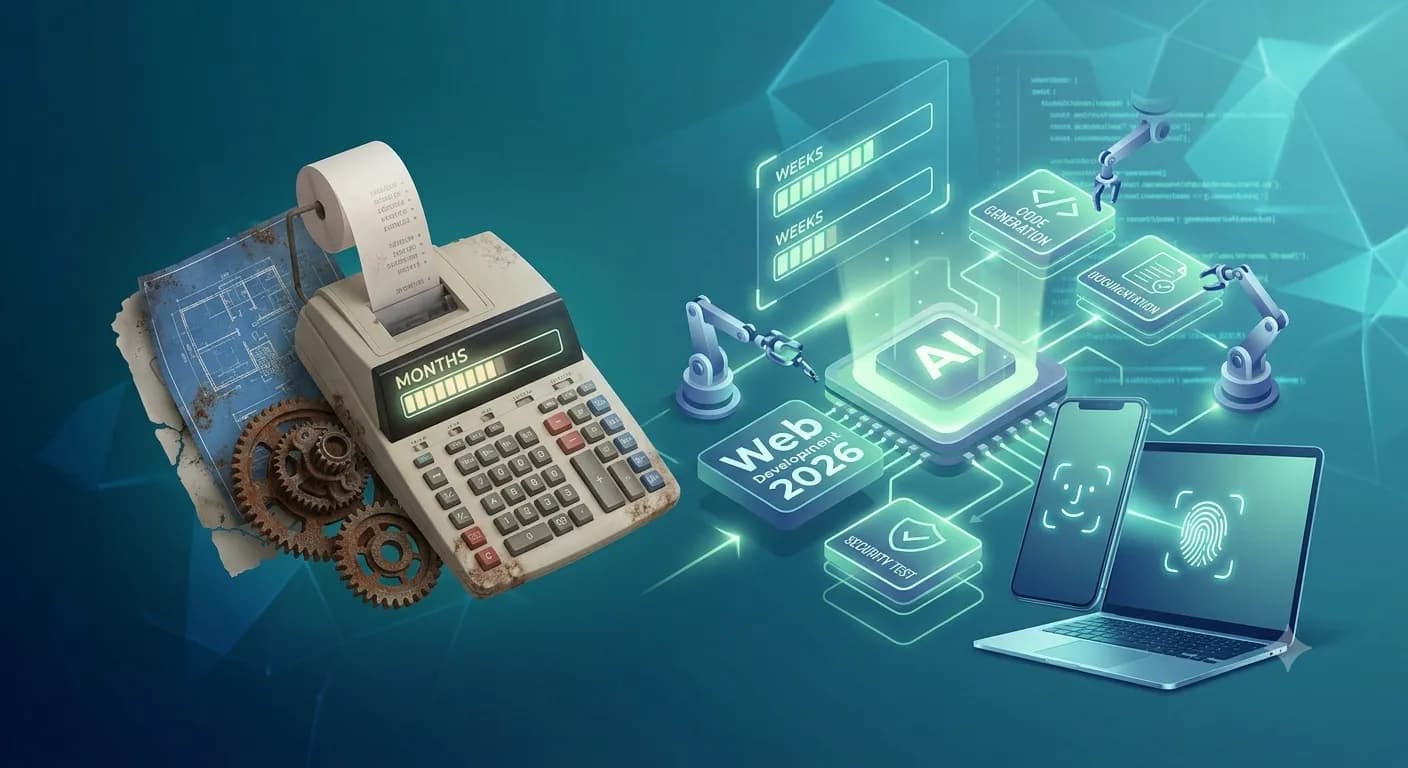
The integration of artificial intelligence (AI) into the technology sector is no longer a forecast for the future — it is a lasting reality that has fundamentally reshaped the digital services market.
While three years ago building a custom website took between 3 and 4 months and required a budget of 5,000 to 15,000 euros, today, in 2026, the same scope of work is delivered within 4 to 6 weeks and costs roughly half as much.
For every business owner, product manager, or entrepreneur, understanding this new pricing reality is critical to achieving a high return on investment (ROI) when planning a new web project.
1. The role of AI in the modern developer's daily workflow
To understand why prices and timelines are shrinking, it's important to analyse exactly what artificial intelligence does in the day-to-day practical work of software engineers. AI doesn't replace strategic thinking, but it eliminates a huge portion of mechanical, routine, and time-consuming labour.
Automated code generation
Modern tools like GitHub Copilot, Claude, ChatGPT, and specialised development environments like Cursor no longer offer merely "sample" or theoretical code. They generate functional, context-aware, integration-ready code based on a detailed description of the business task (prompts). For standard and repetitive tasks — such as building CRUD operations, creating complex contact forms with validation, or integrating basic APIs — AI writes code at 3 to 5 times the speed compared to traditional manual typing.
Lightning-fast debugging and error localisation
Finding broken logic, syntax errors, or library conflicts used to take from minutes to hours, and in more complex software architectures — days. Today, when an error occurs, AI analyses server logs and the error stack in seconds, identifying the exact cause and immediately proposing a working fix.
Deep refactoring of legacy code
Improving the structure of existing code, optimising it for performance, cleaning up duplicated functions, and bringing it in line with modern standards (clean code) is now largely automated. AI handles the tedious, monotonous rewriting work, while the senior developer remains the software architect who evaluates, tests, and approves final changes.
Automatic technical documentation
AI can analyse an entire codebase and generate detailed technical comments, README files, installation instructions, and API documentation within minutes. This ensures that in the future any other developer can easily maintain and extend the website or platform.
Intelligent software test generation
AI generates automated test code in seconds, covering dozens of scenarios that would take hours to test manually, drastically reducing the risk of defects after the site goes live in production.
2. Comparative analysis of delivery time: Before AI vs. Now
The acceleration of web development is most clearly visible through real-world examples:
| Task / Project type | Time before AI | Time with AI (2026) |
|---|---|---|
| Standard landing page (SSR, optimised) | 2–3 working days | 4–8 working hours |
| Contact form (validation, protection, email notifications) | 3–4 hours | 30–45 minutes |
| Third-party API integration (shipping, payments, ERP) | 1–2 working days | 2–4 hours |
| Custom WordPress theme (from scratch) | 3–4 weeks | 1.5–2 weeks |
| Next.js platform (authentication, dynamic content) | 6–8 weeks | 3–4 weeks |
For routine, repetitive tasks the average acceleration is within 2 to 4 times. However, when a project requires complex architectural design, non-standard business logic, and specific product integrations, pure software acceleration is more moderate — around 30–50%, because the focus shifts to human expertise and control.
3. How pricing in the digital services market has changed
The arrival of artificial intelligence created three fundamentally different business behaviour models among digital agencies and software developers.
Scenario 1: Transparent and optimised pricing
Agencies that have successfully integrated AI tools offer a lower final price while maintaining or even improving quality. If a project that previously required 100 hours of work now takes 50 hours, the fair market price becomes proportionally lower.
Scenario 2: Higher value at the same price
Agencies keep their pre-AI price levels but deliver a much more complex end product: automated test coverage, comprehensive documentation, and drastically shorter delivery timelines.
Scenario 3: High prices maintained without added value
Vendors use AI to cut their internal costs in half but continue charging clients at old rates. The agency increases margin without the client feeling any benefit.
4. AI limitations: What artificial intelligence CANNOT replace
Web development has not become a process that can be fully automated with the press of a single button. There are critical aspects where AI is completely limited:
- ✓Strategic software engineering and architecture — choosing the tech stack, planning architecture under high load, and final strategic decisions require years of human experience.
- ✓Implementing specific business logic — discount algorithms, order approval hierarchies, and complex workflows cannot be guessed by AI without precise human analysis.
- ✓UX/UI decisions and user behaviour — user experience design is based on psychology, brand goals, and conversion testing, not just visual templates.
- ✓Integration with non-standard and legacy systems — connecting to old ERP systems, accounting software, or internal tools without public documentation requires an individual engineering approach.
- ✓Information security (Cybersecurity) — AI often generates vulnerabilities. Expert Security Code Review for OWASP Top 10 threats remains mandatory for projects with sensitive data.
5. The "Vibe Coding" phenomenon and hidden business risks
With the mass adoption of accessible generative tools, a new and dangerous phenomenon emerged — "Vibe Coding". People without real technical training build websites entirely through AI, relying only on text commands and blind trust in the machine.
Read more: Vibe Coding — the revolution dividing developers →
Four systemic risks under the hood
- Poorly structured code — a quick fix without refactoring leads to a slow site and SEO damage.
- Serious vulnerabilities — without a security audit, sites remain open to attacks and data leaks.
- Critical technical debt — as you grow, the code becomes impossible to extend; full rewrite remains the only option.
- Impossible to maintain — in a critical outage the pseudo-developer doesn't understand how their software works.
6. Price ranges by project type in the new reality
The web services market is now clearly differentiated based on project complexity and the degree to which AI optimises labour costs:
Corporate / brochure website (5–10 pages)
500 € – 1,200 € with AI · 1–2 weeks
Before AI: 800 € – 2,000 € · 3–4 weeks
Savings: HTML/CSS sections, forms, animations, responsive design.
Human expertise: SEO strategy, information architecture, brand identity, copywriting.
WordPress with custom theme
1,000 € – 2,500 € with AI · 2–3 weeks
Before AI: 1,500 € – 4,000 € · 4–6 weeks
Savings: PHP code, custom fields, admin panel configuration.
Human expertise: Performance, security plugins, compatibility, and scalability.
Online store (WooCommerce / OpenCart)
2,000 € – 5,000 € with AI · 5–8 weeks
Before AI: 3,000 € – 8,000 € · 8–12 weeks
Savings: Catalogues, filters, cart, checkout, Stripe/PayPal, courier modules.
Human expertise: B2B functionality, ERP sync, marketing pixels, data protection.
SaaS platform / Complex web application
10,000 € – 35,000 €+ with AI · 3–8 months
Before AI: 15,000 € – 50,000 €+ · 4–12 months
Savings: Boilerplate code, automated tests, standard UI components.
Human expertise: Architecture, cloud infrastructure, security, scalability.
Detailed pricing overview: How much does a website cost in Bulgaria in 2026 →
7. Three types of developers on the market: Who should you choose?
Type 1: "AI Native" without a technical backbone
Beginner freelancers or newly formed agencies who write good prompts but lack fundamental software education.
Price range: Extremely low
Risk: Critically high — products collapse under scaling or a security audit.
Type 2: Traditional developers without AI
Experienced engineers and conservative agencies who refuse to adopt AI tools in their workflow.
Quality: Very high and reliable
Price range: Extremely high — projects take too long and are uncompetitive.
Type 3: Senior developers with AI tools
Proven specialists with years of experience who use AI for routine work but maintain full technical oversight and strict code review.
Price range: Reasonable market balance
Result: High quality, fast delivery, strong security, and guarantee of future development.
8. Business checklist: How to evaluate a web development quote
Use the following strategic questions to understand whether you're dealing with professionals (Type 3) or risky amateurs (Type 1):
- ?"What AI tools do you use and for which tasks?"
Correct answer: Specific software (Cursor, Claude, Copilot) for tests, documentation, and boilerplate code. "We don't use AI" is a red flag. - ?"How do you guarantee the quality and security of AI code?"
Correct answer: Code review by a senior developer, automated tests, and vulnerability scanning before production. - ?"Who is responsible for architectural decisions?"
Correct answer: A specific Lead / Senior Developer with real experience — not "AI handles everything." - ?"How does AI affect the price and timeline in your quote?"
Correct answer: Logical shortening of timelines and justified pricing for architectural thinking, not mechanical code writing.
9. What does NOT get cheaper despite technological progress
AI is a tool for automating execution, but it has no impact on the following high-value strategic areas:
- ✓Business consulting and strategic planning — niche analysis, user journeys, and business model selection require deep human understanding.
- ✓Unique, authentic brand design — differentiating design that builds trust and resonates emotionally is a complex creative process.
- ✓Long-term SEO positioning — domain authority, link building, and valuable content require ongoing human contribution.
- ✓Legal and regulatory compliance — GDPR and EAA require specialised audits; AI carries no legal liability.
// SINGULARITY EDGE STUDIO
Our methodology
At Singularity Edge Studio, based in Plovdiv, deploying Claude, Cursor, and GitHub Copilot is a standard part of our engineering process. We use AI to accelerate routine processes, automated testing, and documentation generation — but every line of code passes through a four-step filter:
- Code Reviewhuman audit by a senior engineer
- Automated testsload simulation
- Cybersecurity reviewvulnerability scan
- Performance checkpage load speed
Planning a new website, online store, or SaaS platform?
Take advantage of modern technologies without risking your software's security.
Request a free consultation →Conclusion: The future of web development is here
The digital services market has changed irreversibly. Pricing models based solely on artificially inflated billable hours are quickly losing legitimacy.
For business, the current situation offers a unique window of opportunity — much higher technological value, faster realisation of ideas, and a lower required starting budget.
The main challenge is no longer the technical writing of code, but choosing the right partner. When selecting a vendor, stop asking only "How much does it cost?" Ask "What is your workflow, how do you integrate AI, and how do you guarantee the security and quality of my software?"
// TOPICS
Author
Singularity Edge Studio
Engineering studio for web and software — Plovdiv, Bulgaria. We build corporate sites, SaaS, e-commerce, and DevOps infrastructure with a focus on measurable outcomes.
// RELATED FAQ
// MORE ARTICLES
What Is MCP (Model Context Protocol)? A Complete Guide to AI Integrations in 2026
Model Context Protocol standardises how AI models connect to external systems. How MCP works, why it cuts complexity from N×M to N+M, and how businesses can benefit in 2026.
AIOne Developer = a Whole Team: How AI Agents Changed Web Development and Software Engineering
Rakuten cut Time-to-Market from 24 to 5 days with Claude Code. We're entering the era of the "One-Person Crew" — how autonomous AI agents, multi-agent systems, and 1M context windows change ROI, roles, and SEO.
AIHow to Automate Business Processes with AI — A Practical Guide for 2026
Concrete processes, tools, and prices for AI automation in small business. Customer support, documents, CRM, marketing — step by step with an ROI formula and real results.