A few years ago it was enough for your site to look good, load in under 3 seconds and work correctly on mobile. Beautiful design, proper headings and a responsive layout meant you had a modern website.
In 2026, that is no longer enough. The web has undergone its most fundamental shift since smartphones. More users discover companies, products and services directly through ChatGPT, Gemini, Perplexity, Claude and search engines' AI Overviews.
The question is no longer simply: “Is your site beautiful and fast?” The real question is: Is your site ready for AI?
What does AI Ready Website mean?
To understand what an AI Ready site is, first define what it is not.
- ✗NOT just a chat widget in the corner — a floating ChatGPT chatbot does not make the site intelligent. It is a separate service bolted onto existing design.
- ✗NOT just AI-generated content — flooding the blog with mass AI text often leads to penalties and loss of trust.
- ✗NOT just a WordPress or Shopify plugin — AI readiness is not a one-click admin setting.
What AI Ready actually means
An AI Ready Website means the entire architecture, content and technical infrastructure are designed so that:
AI can UNDERSTAND the site
LLMs must instantly parse structure, semantics, context and relationships between elements.
AI can USE the content
Data must be machine-readable, structured and free of technical barriers for crawlers.
AI can RECOMMEND the business
Strong authority and brand signals so models confidently name you when asked “who is best?”
AI can INTERACT
APIs, webhooks and protocols so agents can book, check stock and complete transactions.
Why this already matters
We are moving from Search Engine Optimization (SEO) to Generative Engine Optimization (GEO) and Answer Engine Optimization (AEO).
When someone uses ChatGPT, Gemini, Copilot, Claude or Perplexity, they are not looking for a keyword and a list of sites. They ask a complex problem and expect a synthesised, accurate answer. Search engines are also rolling out AI Overviews. If models cannot extract and verify your information, you lose organic traffic — even if you rank #1 in classic search.
Users in 2026 rarely click five different sites. They ask their AI assistant to compare for them. If your site is not machine-readable, you simply do not exist for that assistant.
GEO guide → · How AI discovers your business →
20 mandatory characteristics of a modern site in 2026
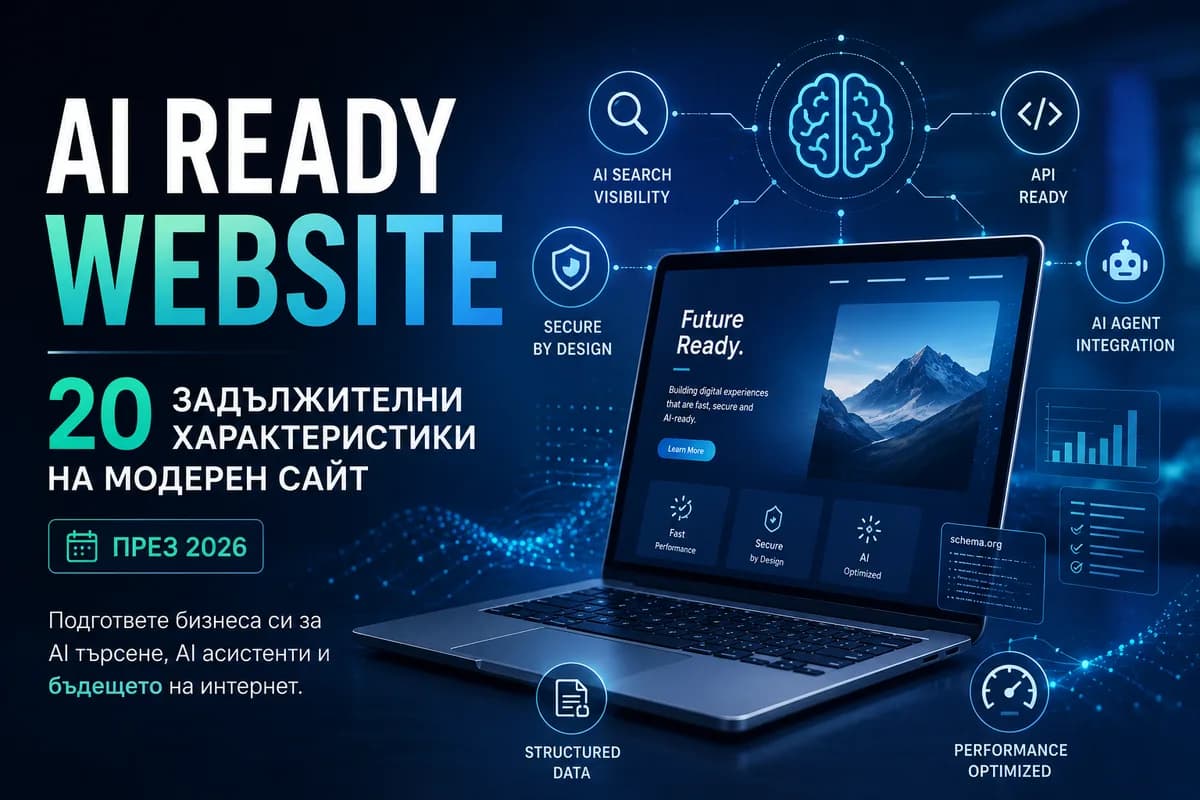
To be fully prepared, your website must cover 20 key characteristics across 4 categories.
Part 1: The foundation (traditional technical excellence)
Without these five classic fundamentals, no AI bot or language model will take your site seriously.
HTTPS and modern protocol security
Security is no longer just a green padlock. Encrypted TLS (with HTTP/2 and HTTP/3) is mandatory. AI bots and search engines ignore and flag sites without proper certificates as untrustworthy.
Mobile-First & Touch-Optimized architecture
Over 70% of global traffic is mobile. The site must be designed for mobile screens first — fast orientation, easy tap targets and adaptive graphics.
Load speed and Core Web Vitals
A 1-second delay can cost millions. Search engines and AI crawlers demand lightning-fast loads:
- ✓LCP — main content under 2.5 seconds
- ✓INP — click response under 200 milliseconds
- ✓CLS — visual stability index under 0.1
Clean, scalable code architecture
LLMs analyse your HTML/CSS/JS. If it is buried in inline styles, heavy frameworks and thousands of unnecessary
div tags, AI struggles to extract real content. Clean semantic HTML5 is essential.
Accessibility (EAA compatibility)
The European Accessibility Act (EAA) is in force. Your site must support screen readers, ARIA attributes, high contrast and keyboard navigation. Interesting fact: AI interprets websites much like screen readers — if you are accessible to people with disabilities, you are accessible to AI.
Part 2: AI must understand the site (semantics and metadata)
With a solid foundation, translate your content into the language AI understands perfectly — structured data.
Deep Schema.org markup
Structured data (JSON-LD) is the “alphabet” for search engines and LLMs. Every element should carry accurate Schema.org markup — product, article, event, review or price.
Organization Entity Schema
Clearly define your company as an Entity: official name, logo, social profiles, address, contacts and related organisations — so AI can build an accurate profile of your business.
Detailed author information
AI prioritises content from proven experts. Every article should include Author Schema
(Person), links to LinkedIn/X and a dedicated biography page with credentials.
FAQ Schema (Q&A)
Sites with Question/Answer format and FAQPage Schema have a dramatically higher chance of being
cited directly by ChatGPT, Perplexity and Google AI Overviews.
Service & Product Schema
Services and products need detailed metadata — prices, availability, warranties,
areaServed, categories and attributes — so assistants can compare and recommend them.
Part 3: AI must trust you (E-E-A-T and brand authority)
Artificial intelligence does not recommend random sites. It filters by trust, reputation and factual accuracy.
E-E-A-T coverage
Content must demonstrate Experience, Expertise, Authoritativeness and Trustworthiness. AI quickly spots shallow text and prefers unique analysis, original research and real case studies.
Brand consistency
Name, addresses, phones (NAP) and core messaging must be 100% identical on your site, Google Business Profile, social networks and directories. Conflicting information makes AI doubt your authenticity.
External mentions and citations
What others say about you matters as much as what you say. Mentions in authoritative media, industry blogs, Reddit, Quora and specialised directories build a trust network that AI continuously analyses.
Knowledge Graph signals
The goal is inclusion in the Knowledge Graphs of Google, Microsoft and OpenAI — by weaving your information with known entities, Wikipedia, Wikidata and official registries.
Regular content updates
AI models update constantly. A site with information from three years ago is considered stale. Regular refreshes with current 2026 data keep algorithms treating you as a relevant source.
Part 4: AI must be able to work with the site
The newest frontier of the modern web: the site is not only read — it performs actions with AI systems.
API-Ready architecture (Headless & REST/GraphQL)
A modern site has an open, secure API architecture. External AI systems and partner software can extract or submit data safely and instantly.
AI-friendly navigation and llms.txt
Just as robots.txt tells search engines what to index, llms.txt provides a
condensed text structure of the site optimised for fast reading by ChatGPT and Claude.
Structured content and taxonomy
Text should be broken into clear sections with H1/H2/H3, short
paragraphs, lists and tables. AI models love ordered information and avoid “walls of text”.
Intelligent on-site search (Vector / Semantic Search)
Exact keyword-only search is outdated. A modern site uses semantic vector search that understands intent — even with synonyms or typos.
Readiness for AI agents (CRM, ERP, Webhooks, MCP)
The site should connect via webhooks and protocols such as Model Context Protocol (MCP) to CRM and ERP. When an autonomous agent requests a booking, quote or purchase — the site must process it without human intervention.
How to check if your site is AI Ready
Use the checklist below. Mark every characteristic your site currently has:
| # | Characteristic / requirement | Points |
|---|---|---|
| 1 | HTTPS and modern security (HTTP/2 / HTTP/3) | 0–1 |
| 2 | Mobile-First responsive design | 0–1 |
| 3 | Core Web Vitals met (LCP < 2.5s, INP < 200ms) | 0–1 |
| 4 | Clean semantic HTML5 | 0–1 |
| 5 | EAA (European Accessibility Act) compliance | 0–1 |
| 6 | Deep Schema.org markup (JSON-LD) | 0–1 |
| 7 | Organization Entity Schema present | 0–1 |
| 8 | Author profiles with Author Schema | 0–1 |
| 9 | FAQPage Schema implemented | 0–1 |
| 10 | Service / Product Schema present | 0–1 |
| 11 | Strong E-E-A-T content | 0–1 |
| 12 | Brand data consistency (NAP) | 0–1 |
| 13 | External citations and mentions | 0–1 |
| 14 | Knowledge Graph presence signals | 0–1 |
| 15 | Regularly updated content | 0–1 |
| 16 | API readiness (REST / GraphQL) | 0–1 |
| 17 | llms.txt file present | 0–1 |
| 18 | Readable structured content | 0–1 |
| 19 | Semantic vector search | 0–1 |
| 20 | CRM/ERP, Webhooks and AI agent readiness | 0–1 |
Score interpretation
- 0–7Critical — built for last decade’s classic web. Practically invisible to AI assistants.
- 8–14Solid foundation — stable traditional site, but missing key semantic and engineering upgrades.
- 15–20AI Ready leader — well prepared for search, AI assistants and future automated integrations.
Common mistakes and myths
“We installed a ChatWidget, so we’re AI Ready!”
The chatbot is an external script. It does not help ChatGPT understand your products or improve indexing.
“We generated 500 AI articles in one day!”
Mass AI content without human expertise leads to “content pollution”. Search engines quickly detect low value and apply algorithmic penalties.
“We use WordPress / Shopify, so we’re ready.”
Ready-made platforms are a framework. Without semantics, code optimisation, APIs and Schema markup, a base template is just a classic CMS.
“The site is Responsive, so it’s modern.”
Responsiveness was news in 2014. In 2026 it is the minimum for survival — not machine readability or AI readiness.
What will sites look like in 5 years? (2031)
- ✓More APIs, less GUI — personal AI agents will talk directly to your site’s API.
- ✓Autonomous Agentic Commerce — transactions between the buyer’s AI agent and the seller’s AI agent.
- ✓Static forms disappear — 10-field forms will be replaced by instant protocols and intelligent dialogues.
- ✓Real-time hyper-personalisation — headlines, images and offers will change dynamically per visitor profile.
Frequently asked questions
What exactly is an AI Ready Website?
A website whose code structure, semantics, content and infrastructure are optimised so AI (LLMs, chatbots, search engines and agents) can easily understand, index, cite and interact with it.
Is WordPress AI Ready by default?
No. Base WordPress is a traditional CMS. You need semantic Schema markup, speed optimisation,
llms.txt, cleanup of excess code and REST API configuration.
Is Shopify AI Ready for online stores?
Shopify has a solid e-commerce base, but is not automatically AI Ready. You need Product entities, semantic search, metadata and CRM/ERP integrations.
What is the llms.txt file and why do I need it?
A modern standard (similar to robots.txt) that gives LLMs a condensed, structured text version
of your most important pages — for easier, faster indexing.
Does ChatGPT use Schema.org markup?
Yes. When ChatGPT and Perplexity scan sites in real time, they rely heavily on JSON-LD and Schema.org to accurately understand prices, attributes, authors and company details.
How do AI search engines find and crawl my site?
Through specialised bots (GPTBot, PerplexityBot, ClaudeBot, Google-Extended) that crawl the web, read structured data and store content in vector databases for answer generation.
What is AI Search?
A search method where instead of a list of keyword links you receive a direct answer synthesised from several of the most reliable sources.
What is Entity SEO?
A concept focused on real-world entities (people, companies, places, concepts) and the relationships between them, rather than isolated keywords.
What does GEO mean?
Generative Engine Optimization — optimising a site and content so generative AI models can easily understand and maximally cite them in their answers.
Will AI fully replace traditional Google?
AI will not remove search engines — it transforms them. Google is already a hybrid platform with AI Overviews, where generative answers take centre stage.
How much does building an AI Ready website cost?
Price varies by scale, API integrations and semantic architecture. The investment is similar to a high-budget custom web project, but delivers significantly higher long-term ROI.
Can an existing old site become AI Ready?
In most cases, sites with outdated codebases need a full redesign. More modern sites can often get a technical and semantic upgrade (refactoring).
Which technologies are best suited?
Headless architectures, Jamstack frameworks (Next.js, Nuxt), vector databases for search, REST/GraphQL APIs and clean HTML5/JSON-LD structures.
How can I check if AI understands my content?
Submit the URL in ChatGPT (Browse Mode), Perplexity or Google Rich Results Test and ask the model to extract key facts, products and authors from the page.
What is the main difference between classic SEO and AI optimisation?
Classic SEO focuses on keyword rankings and clicks. GEO/AEO focuses on brand authority, semantic accuracy and structured data so AI recommends you as the best solution.
// SINGULARITY EDGE STUDIO
AI Ready & GEO packages
We help businesses build AI Ready websites — from technical foundations and Schema.org
to llms.txt, API architecture and readiness for AI agents.
- SEO Audit300 – 600 EUR
- AI Search Optimization (GEO/AEO)500 – 900 EUR
- Monthly SEO + AI planfrom 350 EUR / month
SEO + AI services → · GEO guide → · How AI discovers your business →
Free AI Ready audit
We will check Core Web Vitals, Schema data, llms.txt, bot access and your readiness for
ChatGPT, Gemini and Perplexity — with a concrete next-step plan.
Conclusion
- 2015It mattered that your site was responsive.
- 2020It was critical that your site was fast and secure.
- 2023Strong SEO and content were key.
- 2026It is absolutely critical that AI can understand, respect and use your website.
If your site is stuck in rules from five years ago, you lose customers every day — without even realising it. It is time for change.
// TOPICS
Author
Singularity Edge Studio
Engineering studio for web and software — Plovdiv, Bulgaria. We build corporate sites, SaaS, e-commerce, and DevOps infrastructure with a focus on measurable outcomes.
// RELATED FAQ
// MORE ARTICLES
How Does AI Discover Your Business? Why ChatGPT Doesn't Recommend Your Site — and How to Fix It
Classic SEO is no longer enough. How ChatGPT, Gemini, Perplexity and Claude choose whom to cite, 15 reasons you're invisible, practical tests, llms.txt, Schema.org and a 25-step AI Visibility checklist.
SEOHow to optimise your website for ChatGPT and Perplexity — the complete 2026 guide
AEO, GEO and AIO — what AI SEO is, how AI models choose who to cite and 8 practical steps to become a source of answers in ChatGPT, Perplexity and Google AI Overview.
SEOGEO — Generative Engine Optimization: How to Optimize Your Site for ChatGPT, Gemini, and Perplexity
Classic SEO is no longer enough. GEO is the new discipline for visibility in answers from ChatGPT, Gemini, and Perplexity. What GEO is, how AI chooses its sources, 6 key strategies, and a 90-day implementation plan.